Wednesday, January 16, 2013

Galatians 1:1-5 Messianic Style

In reading my posts many people have quoted Galatians to refute some of the statements that I have made. However, I have not been ignoring Galatians in my writing, rather it only seems that way, since I understand Galatians from a Messianic perspective. It is time for me to address this important book, to demonstrate how traditional Christianity has misinterpreted it and has caused Christians to ignore the Law of God. I would just ask that my readers give my study of Galatians a fair hearing. Thank you!

Galatians 1:1-5 (KJV)
1 Paul, an apostle, (not of men, neither by man, but by Jesus Christ, and God the Father, who raised him from the dead;)
2 And all the brethren which are with me, unto the churches of Galatia:
3 Grace be to you and peace from God the Father, and from our Lord Jesus Christ,
4 Who gave himself for our sins, that he might deliver us from this present evil world, according to the will of God and our Father:
5 To whom be glory for ever and ever. Amen.

Galatians begins with an introduction which is common in letter writing of the day. In this introduction Paul is identified as the author and he stated that he was an apostle. The definition of an apostle according to Free Merriam-Webster online is "someone sent on a mission, as a : one of an authoritative New Testament group sent out to preach the gospel and made up especially of Christ's 12 original disciples and Paul." The question as to whether or not there were other apostles besides these listed, as well as whether there are apostles today is beyond the scope of this discussion and will be left to another time.Verse 1 also informs the reader that Paul became an apostle based on the authority of Yeshua the Messiah and of God the Father and not by the authority of any man. It is stated that God the Father raised Yeshua from the dead. 

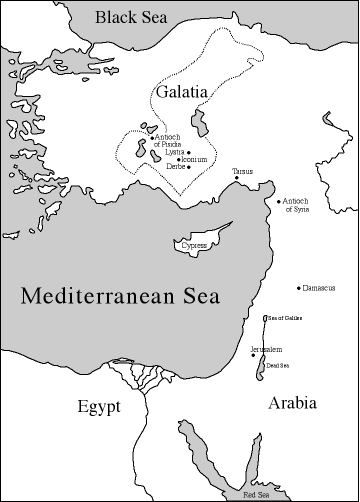
Verse 2 gives us further information that this letter was not only from Paul, but from the brothers in Yeshua that were with him. He wrote this letter to the churches of Galatia. Galatia is located in central Turkey where Paul had established several churches (Act 13:51-14:23). The word translated "churches" is the Greek "ekklesiai" which refers to the Messianic congregations that Paul had established. (See map below.)

Roman Province of Galatia
25 B.C. ­ 137 A.D.


Paul greeted the congregations in verse 3 by expressing his desire that grace and peace from God the Father and Yeshua the Messiah would be given to them. Verse 4 sums up what Yeshua had done for the believers. He gave Himself for their sins in order to deliver them from the evil world in which they lived. This was according to the will of God, who is their Father. Verse 5 gives God the recognition that glory belongs to Him forever and ever. Paul ended with "Amen" which is a solemn ratification or agreement of what had been said (Dictionary.com).

The introduction that Paul gave sets the tone for what is to follow. He stated what the true Gospel message is and we will see its contrast in the next verses.

Next:

Monday, January 14, 2013

The Most High God - Daniel 3:13-18

Previous:

When the mighty king of Babylon was told that Shadrach, Meshach, and Abed-nego had not worshiped his golden image, how did he respond?

Daniel 3:13-18 (KJV)
13 Then Nebuchadnezzar in his rage and fury commanded to bring Shadrach, Meshach, and Abednego. Then they brought these men before the king.
14 Nebuchadnezzar spake and said unto them, Is it true, O Shadrach, Meshach, and Abednego, do not ye serve my gods, nor worship the golden image which I have set up?
15 Now if ye be ready that at what time ye hear the sound of the cornet, flute, harp, sackbut, psaltery, and dulcimer, and all kinds of musick, ye fall down and worship the image which I have made; well: but if ye worship not, ye shall be cast the same hour into the midst of a burning fiery furnace; and who is that God that shall deliver you out of my hands?
16 Shadrach, Meshach, and Abednego, answered and said to the king, O Nebuchadnezzar, we are not careful to answer thee in this matter.
17 If it be so, our God whom we serve is able to deliver us from the burning fiery furnace, and he will deliver us out of thine hand, O king.
18 But if not, be it known unto thee, O king, that we will not serve thy gods, nor worship the golden image which thou hast set up.

Verse 13 tell us that King Nebuchadnezzar had the three men brought before him. What question did he ask in verse 14? He asked the three men if what he had heard was true, that they didn't serve his gods or worship the golden image. Undoubtedly, Nebuchadnezzar was aware that these men worked as government officials, but it does seem likely that Daniel was not in Babylon at the time, since he is not mentioned. In verse 15 the king gave the men another chance. If they fell down and worshiped, everything would be well, but if they didn't what would happen to the men? They would be cast into the midst of a burning fiery furnace. What else did the king say? The king asked, "Who is that God that shall deliver you out of my hands?" Remember how Nebuchadnezzar had acknowledged that Daniel's God was the greatest God in chapter 2? He seemed to have forgotten his experience with Daniel's God and how Daniel had told the king about his dream and its interpretation. Before we cast any disparaging comments about Nebuchadnezzar's stupidity, we should recognize that we, as humans, are a very forgetful, ungrateful race as a whole. Nebuchadnezzar, after all, was the most powerful man in the world at the time. The proud are the most forgetful and ungrateful people! In verse 16 how did Shadrach, Meshach, and Abed-nego answer the king? Their response indicated that they were not trying to give the king crafty ideas about why they behaved as they did. Verses 17 and 18 gives their forthright answer. If the men were thrown into the furnace, their God would be able to deliver them. However, if even their God did not deliver them they still would not serve Nebuchadnezzar's gods, nor worship the golden image.

This portion of Daniel teaches us a great deal about God's sovereignty, our prayers, our expectations of prayer, and faith.

God is in control of all things. He does what He knows is best according to His plans. When we pray we don't command a genie to do our will, rather we pray that God's will is done. When we pray for particular outcomes, God may veto them if our prayers are against His will. Yet, true faith understands that whatever God does is right and we will accept His will.

What happened next? Were the men thrown into the fiery furnace? If they were, did God deliver them or not? Stay tuned!

Next: